Fred Unboxed is a new digital exhibition launched by the Fred Rogers Center for Early Learning and Children’s Media at Saint Vincent College. The exhibition showcases items curated from the life and career of Fred Rogers, who – among his other roles as an entertainer, teacher, and Presbyterian minister – was also a prodigious self-archivist, exercising first-rate personal recordkeeping since his youth. His archive of over 22,000 items includes school notes from his childhood, television scripts, handwritten songs, speeches, correspondence, and familiar objects from Mister Rogers’ Neighborhood such as the Neighborhood Trolley and the puppet Daniel Striped Tiger. For generations of children, Fred Rogers, better known as Mister Rogers, was an icon whose familiarity made him more like a family member than a television personality. Although Rogers passed away in 2003 and his groundbreaking television programs have been off the air for almost two decades, the soft-spoken children’s entertainer is still well-known, due at least in part to two high-profile films released in the past two years: the documentary Won’t You Be My Neighbor? (2018) and a Hollywood film starring Tom Hanks, A Beautiful Day in the Neighborhood (2019). His memory is firmly planted within our cultural consciousness. Yet it is only through the work of the Fred Rogers Center, with the archives at its core, that Fred Rogers’ message of caring and self-acceptance can continue to impact new generations of children. By activating Rogers’ archival legacy and making it accessible to parents and child-serving professionals, the centre carries Rogers’ torch of advocacy and continues his thoughtful approach to child development.
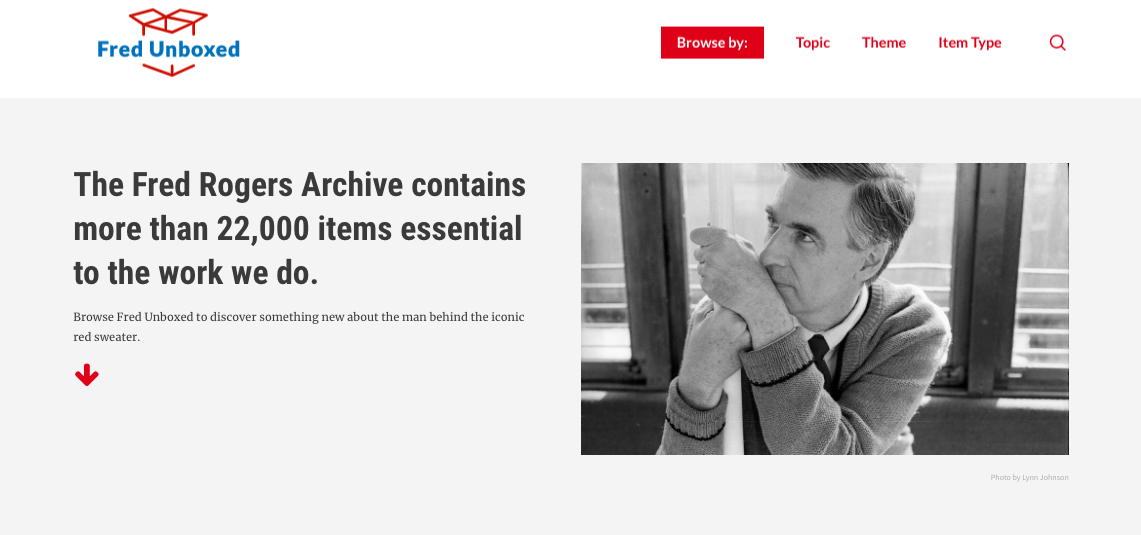
Fred Unboxed is a curated selection of archival artifacts drawn from the Rogers archive. The exhibition currently consists of 40 archival objects, including handwritten song lyrics, behind-the-scenes photographs, oral history interview clips, and video clips of meaningful moments from the television programs, for example, “Mister Rogers Visits Russia,” “Mister Rogers Visits with Yo-Yo Ma,” and “Mister Rogers Talks about Divorce.” The showcased items, selected by Emily Uhrin, senior archivist at the Fred Rogers Center, are categorized by topics, whose themes correspond to concepts that are useful for any person responsible for the care of children: anger, communication, education and learning, family, helping behaviour, imagination and fantasy, individuality and identity, love, music, and play. Items are cross-referenced with tags related to their themes, the names of which are taken from the songs sung by Rogers, such as “It’s You I Like” and “There are So Many Ways to Say I Love You.” Every item is also tagged by material type: photograph, paper document, or video. The exhibits conform to archival principles by focusing on the archival qualities of every item, including its context, date of creation, and type. The design satisfies the archivist’s need for context and orients the user to consider the documents, images, and videos not as snippets of information but as archival objects.
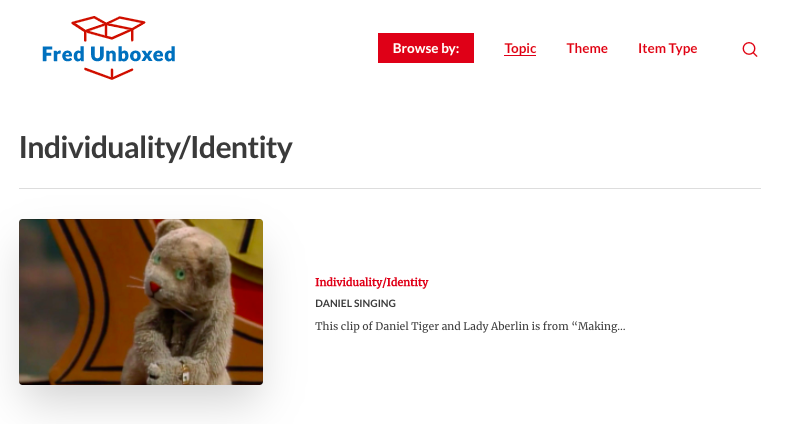
In some respects, Fred Unboxed resembles a digital archive more than an exhibition. Unlike a strictly exhibit-like digital space that recreates a museum experience through the use of narrative and virtual guided tours, Fred Unboxed offers visitors digital objects that are contextualized and searchable by theme and type. The site’s similarity to an archives is a feature, not a flaw. Instead of encountering a narrative or story-based experience, the visitor is encouraged to actively engage with the objects and consider their usefulness as teachable resources. One might have expected to find a biographical narrative of Rogers’ life, supplemented with illustrative archival documents and images. It is possible to imagine an exhibit that capitalizes on the resurgence of “Mister Rogers” as a brand by flashing familiar images – such as the iconic red cardigan – and text blocks that idolize Rogers as a cultural icon of goodness and unassailability. Fred Unboxed does not take this approach. It forgoes what a casual visitor might expect from an exhibition singularly focused on an individual and their archive. While Rogers’ biography is well-known already and accessible elsewhere, the exhibition’s higher purpose is to embody the qualities and philosophy that informed Rogers in his work as an educator and advocate and, in doing so, to continue that work.
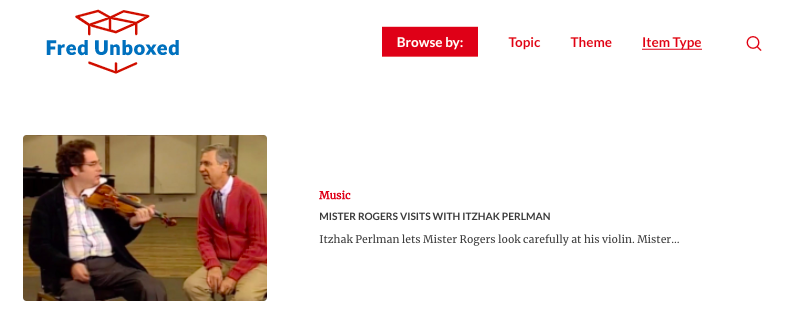
In the absence of narrative, the exhibition is centred on the archival objects themselves. These objects are described in a manner that invites visitors to interact and engage with them. For example, the description of an embedded video of a conversation between Rogers and Itzhak Perlman introduces the interview with well-mannered and unpatronizing language modelled on Rogers’ style of speaking to his young viewers: “Itzhak Perlman lets Mister Rogers look carefully at his violin.” The clear and simple language suggests that it is meant to be read aloud by those who are supervising children online: parents, teachers, day-care workers, educators, social workers, and children’s librarians. Although Fred Unboxed employs child-friendly language, its visual interface is understated, with black text over a white background. The back-end design of the exhibition suggests that adults are the target audience, as the access controls of the site encourage sharing the content digitally. Visitors can search by item type, and every item is accessible in a shareable format; all documents can be downloaded as PDFs, all images can be downloaded as medium-sized JPEG files, and videos are publicly shareable via links hosted on the video-sharing platform Vimeo. This simplified access implies an active use and sharing of the materials offered as teachable resources, rather than passive browsing for entertainment.
Fred Unboxed demonstrates how technology can be used an an educational tool to foster positive values such as self-acceptance, compassion, and concern for others. The exhibition typifies the challenge and concern regarding digital projects within educational environments. The essential question for both educators and digital designers today is, How can technology enrich human relationships instead of replacing them? The Fred Rogers Center leads by example, showing how digital elements can play a role in education and childhood development without diminishing the role of human interaction and relationships in a child’s daily life. Given the shift from in-person to online learning as a result of the COVID-19 pandemic – a transition that will likely outlast the pandemic itself – access to online resources that are enriching for children is vital. The work of the Fred Rogers Center in this regard is instructive. As archivists, we advocate for the use and recognition of archival objects in educational settings and we encourage students to “think archivally” regarding context and material type. Fred Unboxed demonstrates that it is also possible to create enriching digital archival engagement for primary school learners. In the words of Fred Rogers, “Technology is neither good nor bad, it’s how we use it that matters.”[1]