Introduction
In April 2020, Special Collections & Archives (SCA) at the University of Waterloo Library (UWaterloo) in Waterloo, Ontario, released a revised statement on language in archival descriptions. The changes were introduced as an intentional integration of equity- and reconciliation-informed thinking into the department’s archival practice. Consisting of a series of descriptive interventions to address the perpetuation of systemic and cultural bias, they were established to support ongoing efforts by staff to identify and acknowledge known instances of discrimination that appear throughout SCA’s holdings. The formalization of these interventions was directly informed by the landscape in which the department operates, including governing policies and standards in place on campus and within the profession as a whole.[2] They were equally informed by sustained calls for accountability within the archival profession regarding its role in upholding homogenous historical narratives rooted in the assumed supremacy of cis-, able-bodied whiteness.[3] This desire for accountability also responds to the calls put forth by the Truth and Reconciliation Commission of Canada with regard to education about and access to records related to the residential school system and the settler colonialism that informed the system’s creation.[4] Finally, the changes demonstrate an attempt to meaningfully put organizational and personal commitments related to equity and reconciliation into practice.
What follows is an overview of how SCA staff have begun to transition beyond making vague, blanket statements about the era in which records were produced to explore reconciliatory actions that go beyond the rote land acknowledgements now common within academic spheres.[5] This article is an attempt to talk openly about the work and reflection required to push aside desires to have the right answer before implementing change(s), to get comfortable with not confidently knowing how, and to make good-faith improvements anyway. It is a means of holding myself, my colleagues, and my place of work accountable by documenting the why and how of where we find ourselves, from an equity and reconciliation standpoint, and by demonstrating how things are progressing as we attempt to shift that position over time. Finally, it is a contribution aimed at addressing an absence, in the related literature by Canadian archival practitioners, of discussions about the equity- and reconciliation-related revision and remediation of archival descriptions.
Beginning with an overview of the department and the landscape in which it operates, this article provides a brief review of guidance available in the Rules for Archival Description. It then provides the rationale behind the recent changes to descriptive practice before exploring a series of examples of how and where this work is newly underway. The article concludes with a consideration of current identified challenges and the related work ahead.
Department Overview
Special Collections & Archives opened in 1976, although its roots date back to the 1960s, when UWaterloo’s first university librarian, Doris Lewis, began overseeing the collection of rare books and archival records. One of the department’s foundational donations was the Lady Aberdeen Library on the History of Women, donated in 1967 as a Canadian Centennial project by the National Council of Women of Canada (NCWC).[6] It was followed by donations of papers by both the NCWC and its members, which in turn attracted donations from Canadian writers, journalists, and broadcasters affiliated with the Canadian Women’s Press Club. Today, the department maintains several hundred fonds and collections reflecting 15 thematic areas[7] in addition to an extensive collection of rare books and periodicals. The department is unique among Canadian academic archives due to an extensive and heavily used local history collection that reflects the development of the region – holdings that are more commonly found in public, municipal, or community archives. Among these is the heavily used Kitchener-Waterloo Record Photographic Negative Collection, consisting of approximately 2 million negatives shot between the late 1930s and 2001, when the newspaper transitioned to digital photography.
The department mandate is to acquire and make available material that supports the goals of the major teaching and research programs at UWaterloo.[8] In doing so, SCA is a public-facing department, meaning that staff regularly assist the public with everything from questions about local buildings or family-related research to more in-depth requests tied to film productions or retrospective events and exhibits. SCA is also responsible for maintaining and providing access to the University of Waterloo Archives (UWA), which preserves recorded information of enduring administrative, legal, financial, or historical value related to the university.[9] Prior to the onset of COVID-19, the department averaged 1,200 reference requests per year from on- and off-campus researchers who made contact by phone, email, and in person regarding holdings in both SCA and the UWA.[10]
There are currently six full-time staff members in the department: four librarians or archivists, including the head of the department, and two library associates.[11] In addition to the full-time staff, SCA relies on part-time assistance from the library’s cataloguing department to help with the processing of rare books and historical maps. There is also often at least one UWaterloo co-op student or an MLIS student from another university working in the department each term to assist with scanning, data entry, rehousing, and other day-to-day operations.
Equity and Reconciliation in the Waterloo Landscape
SCA’s current approach to language in archival descriptions was formalized in April 2020, the result of discussions that have been underway for several years. The corresponding statement about the changes was influenced by suggestions for enacting transparency regarding descriptive interventions to address racism, which were put forth by the Archives for Black Lives in Philadelphia Anti-Racist Description Working Group.[12] The formalization and public sharing of changes to SCA’s archival description practice has been heavily informed by the environment in which the department operates – both inside and outside the library as well as on and off campus.
At the department level, there was a complete staff turnover in the mid-2010s. The current team has been with the department for anywhere from three to seven years, meaning that we are well positioned to reimagine and redirect how the department operates and what new or existing services get prioritized. One of the earliest identified priorities was to improve online access to the department’s holdings and the information available about them. This decision marked an intentional shift from an operational focus predominantly aimed at accommodating in-person, private research pursuits to an active, outward-facing archival program aimed at inviting in researchers – both those using archives for the first time and seasoned experts. Shortly after I started, in a newly established digital archivist position in 2016, I was tasked with overseeing the launch of the Waterloo Digital Library (which runs on Islandora), which is used to share a selection of the department’s digitized records. I am also responsible for the management and ongoing migration of descriptive records from a series of internal databases to the Archives Database (which runs on AtoM), an online descriptive platform launched in 2019 to facilitate open and evolving access to SCA’s descriptive records.[13]
The launch of the Waterloo Digital Library and the Archives Database prompted a focused and ongoing review of legacy descriptive records. Although the review process has been slow and time intensive, the resulting (re)description work represents a high-impact net benefit since more information online means more people seeing, using, and drawing conclusions about the records SCA has to offer. That reality has resulted in a sustained consideration of how to best present information about the records in the department’s care, particularly those documenting a less savoury aspect of the era in which they were produced. Initially, problematic content[14] shared online was accompanied by a note indicating that the ideas expressed did not reflect UWaterloo’s views, an approach SCA staff quickly realized works only until someone questions why they do not reflect the views of the school.
From a campus standpoint, it is important to note that, in the summer of 2020, UWaterloo’s Associate Vice-President for Human Rights, Equity and Inclusion, Diana Parry, resigned following sustained criticism from #EQUITY4WHO, a grassroots student group that openly documented the repeated shortfalls of equity and anti-racism efforts on campus with regard to the needs of Black and Indigenous students, staff, and faculty.[15] Although this is a recent example, the concerns that led to the resignation have been raised and, in some cases, have been present on campus for years. In 2017, members of the Black Association for Student Expression were told by school officials that they would have to collect statistics themselves in order to prove a shortage of on-campus services for Black students, since the school did not collect data about racialized students.[16] Data and equity were also at the forefront of campus happenings in 2016, when UWaterloo increased the compensation of women faculty members after an internal review determined that a “systemic gender anomaly” was resulting in inequitable pay.[17]
Finally, the history of the Region of Waterloo needs to be considered as it directly impacts both the collections and the operations of SCA. The region is situated on the Haldimand Tract, land that was promised to the Six Nations in 1784 in return for their support of the British during the American Revolution. It includes six miles on each side of the Grand River.[18] What is today Kitchener-Waterloo was first settled by Mennonites from Pennsylvania in the early 1800s. As the region grew and developed into Ontario’s industrial hub, wealthy, predominantly white industrialists followed. Although the region today is culturally diverse – partly due to the international draw of various science and technology companies and multiple universities and colleges – its German heritage has continued to be a primary focus within local history communities and features prominently in tourism experiences like Oktoberfest and St. Jacobs Farmers’ Market. Unfortunately, the pride associated with the region’s more homogenous roots can be linked to persistent race-based discrimination and an inclination, particularly among white citizens, to deny that skin colour is a source of that discrimination. Recent examples include the dismissive responses to Indigenous community members’ concerns about the appropriateness of the Prime Ministers Path in Baden, Ontario, following repeated vandalizations of the Sir John A. Macdonald statue;[19] the racist behaviour directed toward Land Back advocates in Kitchener’s Victoria Park;[20] and police chief Bryan Larkin’s undermining of the reliability of a data-driven report that showed that 66 percent of the people who experienced use-of-force responses from Waterloo Regional Police between January and June 2020 were Black.[21]
On their own, these various snapshots of the landscape in which SCA operates may not seem immediately related, but combined, they can be understood as an unignorable perfect storm. SCA is working to push forward services that improve access to and awareness about its holdings against a backdrop of important and challenging discussions about equity, race, and reconciliation. And staff are doing so as requests for primary resources related to equity-seeking groups and the rhetoric used to push them to the margins are on the rise in both personal research and instructional contexts.
Equity, Reconciliation, and the Rules for Archival Description
The announcement about the formal changes to SCA’s approach to language in archival descriptions noted that the existing archival descriptive standards lacked clear, current directions for handling problematic content.[22] While that remains true, the Rules for Archival Description (RAD), the descriptive standard followed by the department, can be used to rationalize the introduction of equity- and reconciliation-informed thinking in day-to-day archival practice. For example, RAD outlines three core purposes of archival description:
- To provide access to archival material through retrievable descriptions;
- To promote understanding of archival material by documenting its content, context and structure; and
- To establish grounds for presuming the authenticity of archival material by documenting its chain of custody, arrangement, and circumstances of creation and use.[23]
Although there are many ways to interpret descriptive standards, these particular points can be understood to emphasize the importance of describing records so that they are findable and so that the context in which they were created is clearly documented. Further, they emphasize that this should be done in a way that best meets the requirements of the set of records, the needs of end-users, and the environment in which they are being used. Considered from a practitioner standpoint, one can reasonably interpret RAD’s direction as empowering SCA staff and holding them responsible for providing access to archival records in a manner that interacts with, speaks to, and accurately documents the moment in which they are being used.
Reasons for Expanding the Statement
Ultimately, SCA staff needed to determine how to engage with broader discussions taking place around us while, at the same time, working to better reflect the realities of the people we were mandated to serve and whose histories we had been tasked with documenting. Not to acknowledge or understand the depth of this moment would have been to fall short with regard to accurately capturing and talking about the history of the department, UWaterloo, and the region, and it would also have meant neglecting the department’s mandate to support the interests of on- and off-campus researchers. Not making the changes might have also inadvertently signalled to potential researchers and donors that the department existed only to document a certain type of history and uphold a certain type of narrative around this.
To that end, in April of 2020, SCA released a revised statement regarding language in archival descriptions, which outlined areas of focus related to equity and reconciliation efforts in day-to-day practice. The changes reflect a formalization of ongoing staff efforts to acknowledge known instances of discrimination that appear in archival records. Although staff had previously relied on a general acknowledgement of problematic language in archival descriptions, this had amounted to a blanket statement about historical records reflecting the era in which they were produced.[25] That approach was not necessarily bad, and it continues to be employed by many cultural organizations. What complicated the approach for me was an increasing discomfort with the “sorry if you were offended” tone that is implied in these kinds of statements – in part because it highlights a disconnect between my stated commitments to equity and reconciliation, as well as those of my place of work, and the reality of putting those beliefs into action in both my personal and professional life. I feel strongly that if individuals and organizations say that we are serious about addressing and dismantling racist and colonial structures, we need to act in ways that demonstrate, enact, and enable that desire. We also need to be very clear about why we are doing it. Thinking critically and intentionally about the language used in descriptive records is one way to follow through on those commitments.
The turning point in SCA’s approach to archival descriptive work took place in 2019, while my colleague Sue Plouffe was seeking knitting-related photos to promote an event. She found what she initially thought would be a good candidate, from 1965, only to realize once the image was scanned that it included an unequivocally racist depiction of a Black man as part of a “Boys Slave Day” event at a local high school.
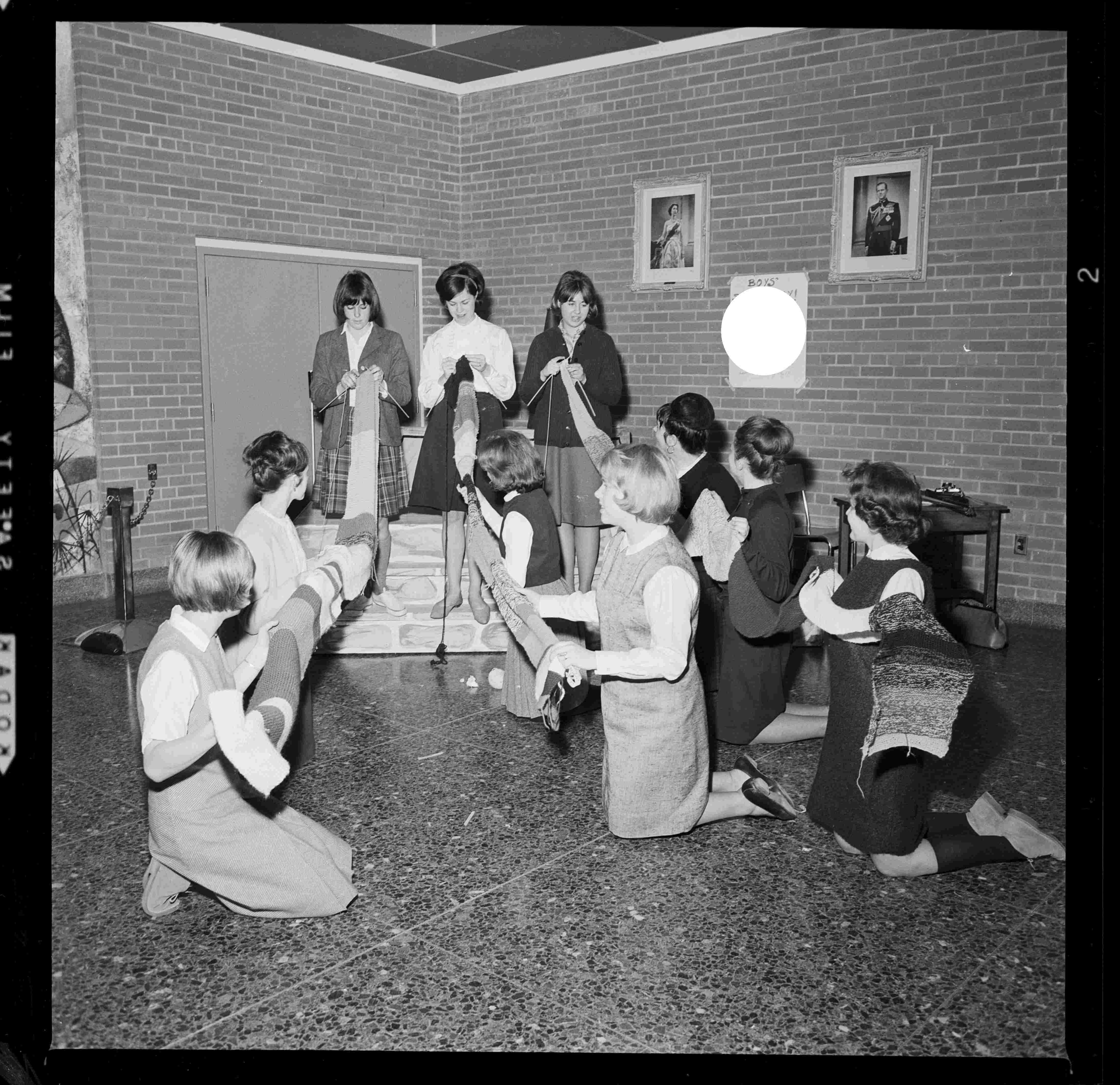
Figure 1: Negative from the Kitchener-Waterloo Record Photographic Negative Collection, titled “Waterloo High School Knitting Bee.” Source: University of Waterloo Library, Special Collections & Archives, Kitchener-Waterloo Record Photographic Negative Collection, 65-1330_004, Waterloo High School knitting bee, February 26, 1965.
Even with the racist poster obscured,[26] it is worth noting how seamlessly racist imagery and ideas are woven into seemingly innocuous historical records and, more to the point, our daily lives. For example, the quaint-sounding photo title – “Waterloo High School Knitting Bee” – does not hint in any way at the racism openly displayed in the poster.
Everyone working and studying at this school would have seen it and would have had an opportunity to object to the event. At the same time, while the photographer could have reframed the shot, the advertisement is visible on the wall as if racism is just obvious – a given that no one thinks, or thought, twice about. If we, as a department, had not already been discussing the impact of unacknowledged racist content in the records we publicly share, this may have gone unnoticed, not because we are okay with open displays of racism, but because the poster is relatively small and quietly woven into the rest of the shot, making it easy to miss.
Once the racist poster was identified, an easy decision was made to exclude the image from the department’s promotional effort, and this was followed by discussions about how to document and track known racist content in our descriptive records. Prior to the launch of the Archives Database, we would have added an internal note to the relevant record that only staff could see, but the description for this photo is now public, and we needed to figure out how to identify the issue. The solution we settled on was to add a content warning to the general note field that reads, “Boys’ Slave Day poster with racist depiction of a Black person visible on wall behind knitting bee participants.”[27] Euphemisms were intentionally avoided, and racist was used to identify the issue clearly and accurately. Work on this front has since been expanded to document instances of black-, brown-, yellow- and redface, particularly in historical photographs of children and costume parties, where this form of racism is rampant.
Stated Commitments in Action
Since publicizing our decision to address problematic language and content more intentionally, SCA staff have been asked repeatedly for examples of interventions in action. Beyond identifying forms of discrimination immediately apparent in photographic material, we have established a series of descriptive guidelines for reference during the (re)description process. The work to enact them has only just begun and is being executed as descriptions are reviewed for migration across platforms, as records are described for the first time, or as problematic content is identified during instruction- or reference-related work. The still evolving guidelines shared below demonstrate some of SCA’s stated commitments in action, several of which are tied to photographic records and the identification of racialized bodies, in keeping with the nature of our holdings and the (known) issues within them. The examples are not offered as exhaustive or definitive solutions to the identification of discriminatory records or as an unchangeable statement about how SCA will continue the work moving forward. They are offered instead as possible approaches for enacting equity- and reconciliation-focused interventions in your own descriptive practice and should not be taken as comments about how or where to start; each archivist will have to decide how to proceed based on the unique circumstances and uses of the records in their care.[28]
Remove and avoid the introduction of comments such as “never married” or “had no children” within biographical sketches unless these are relevant to the context of related records. The immediate reason for this guidance is rooted in equitable description as these types of caveats are rarely, if ever, noted when describing men but are common in overviews of the lives of women. This is also an attempt to reflect historical social realities and to make more transparent the systemic discrimination that women, particularly women of colour, have faced over time. Women, for example, were unable to get married if they wanted to have or keep careers. Women could not marry same-sex partners. Women could not marry if they found themselves, willingly or not, in caretaker roles, looking after war-wounded siblings or disease-stricken parents. Finally, women do not have to marry or have children to live meaningful, fulfilling, and well-rounded lives, yet archival descriptive practice has encoded suggestions that they do by needlessly commenting on what their lives lacked.[29]
Avoid unnecessary assumptions about gender or sex. As part of the item-level description I do prior to sharing digitized items online, I tend to prioritize the use of a person’s name, when known, or to use unidentified person, when it is not, rather than defaulting to she or he. I also make every effort to use generalized statements such as “Members of [women’s association name here]” rather than “Group of women.” The decision to avoid unnecessary assumptions about gender or sex was intended to subvert any tendency to assume someone’s gender based strictly on appearance. That said, this intervention requires case-by-case implementation rather than universal application due to its limitations. There are certain instances where indicating the presence of men or women, regardless of known affiliations or identifications, is essential to understanding the historical value of the records at hand. SCA’s local history holdings include early photographic evidence of influential industrial companies such as Dare Foods, Dominion Rubber, Kaufman Shoes, and Schneiders. Knowing about the presence of (white) women in factory settings at the turn of the 20th century or during periods of war is critical information for scholars studying historical labour relations, suffrage movements, and shifting family dynamics within Canadian society. Therefore, simply referring to a group of workers as “employees” without signalling the presence of men and women makes invisible records that are significant from a local and social history standpoint.
Prioritize family-inclusive language when and where appropriate. SCA staff have deemed this aspect of descriptive work important because, while it is easy to think of non-nuclear or non-traditional families as contemporary occurrences, they have always existed. A common example are families with children who were raised by their grandparents or other extended family members, perhaps because of previous pandemics, wars, or parental migration or incarceration. Another example are those children who have been adopted or fostered by caregivers for any number of reasons, including the ongoing removal of Indigenous children from their home communities. There are also countless among us who have found and cherished chosen families in the absence of biological familial entities due to forced separation, transphobia, homophobia, or other forms of discrimination and abuse people experience simply for existing. All these families, regardless of the reasons they have been brought together, deserve to have the circumstances in which they live respected and dignified. Being more inclusive with descriptive language, particularly at the item level, when images depicting unknown familial relationships are shared online is a way to make sure that happens. Basic examples of this practice in action include substituting adult or caregiver for (an assumed) parent – and baby, infant, or child in place of son or daughter.[30]
Add and expand existing fonds- or collection-level content warnings. Figure 2 is a screenshot from a collection included in the Waterloo Digital Library. It contains highly used and requested records from the Parents’ Information Bureau (PIB), a Kitchener organization created in the 1930s to promote and distribute birth control. The PIB and the thinking behind its operations and services were heavily informed by eugenics, specifically, the belief that the human population could be improved by limiting the reproduction of “inferior” people.
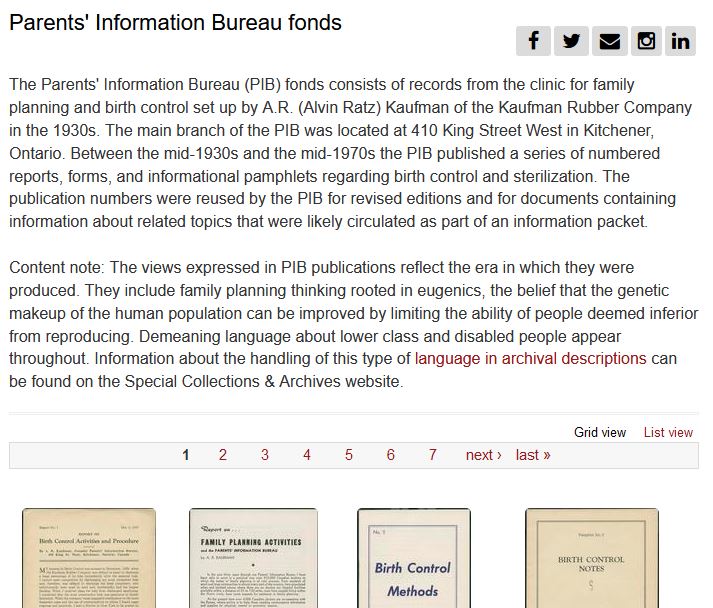
Figure 2: Screenshot of the overview and content note for the Parents’ Information Bureau fonds in the Waterloo Digital Library. Source: “Parents’ Information Bureau fonds,” University of Waterloo Digital Library, accessed October 24, 2020, https://digital.library.uwaterloo.ca/uwdl-9e449512-8478-4513-800d-f1716e9bcd27/parents-information-bureau-fonds?display=grid
To more immediately identify the records within the PIB as lk63160505", a content note was added to the fonds-level records in both the Waterloo Digital Library and the Archives Database. It reads, “The views expressed in PIB publications reflect the era in which they were produced. They include family planning thinking rooted in eugenics, the belief that the genetic makeup of the human population can be improved by limiting the ability of people deemed inferior from reproducing. Demeaning language about lower class and disabled people appear throughout.” The note is by no means a perfect solution, and similar warnings do not appear in each of the item-level records where dehumanizing language appears,[31] but this type of fonds-level note is an improvement over the note that was previously associated with this collection: “The views expressed here don’t reflect those of UWaterloo.”
Facilitate improved access to records related to Indigenous communities. Although much of SCA staff’s attention has been directed at revising and avoiding the introduction of problematic language in descriptive records, initial attempts have also been made to better identify records pertaining to First Nations, Métis, and Inuit in Canada. Since we hold very few fonds or collections directly related to or created by these groups, we are paying particular attention to instances where it is not otherwise apparent that information related to Indigenous peoples is included within a larger set of records. One example of this practice was established when historical maps in our holdings were catalogued and digitized for improved access.

Figure 3: Map depicting districts in Rainy River and Thunder Bay that includes great areas marked with IR to denote Indian reservations. Source: University of Waterloo Library, Special Collections & Archives, G24493, Rainy River and Thunder Bay Dist., n.d.
The map in figure 3 documents the districts in Rainy River and Thunder Bay, which is the aspect of aboutness that would normally be prioritized in the corresponding catalogue record. The map, however, also includes a series of grey-shaded areas that are not included in the legend but are marked with the initials IR, indicating the location of Indian reservations. Following consultation with various colleagues,[32] “Indigenous peoples – land tenure” was added to maps where information about Indigenous land was included but was not the focus or purpose of the map.
While some may argue that this type of intervention goes against traditional cataloguing practice, from a reconciliation and archival descriptive standpoint, SCA staff have the authority and ability to add the access points deemed most appropriate for end-users. For example, while the residential school system is often the entry point for people’s thinking about reconciliation, colonialism and the cordoning off of land for colonial settlement versus Indigenous livelihood is a key part of understanding the thinking behind the school system. Surfacing related information is a way to highlight that relationship. Including land tenure authorities is also a way to help surface information that can be referred to and used as part of land claim processes across the country.[33]
This type of authority work has been expanded to include the intentional use and introduction of more precise descriptive language pertaining to Indigenous peoples in Canada. The effort has been made to facilitate keyword searching based on current, culturally precise language as a means of addressing the gap in our holdings related to Indigenous peoples and themes. The finding aids for records in the E. Palmer Patterson Fonds are one such example.[34] They were recently redescribed by archivist Nicole Marcogliese to refer to First Nations and Inuit using current and appropriate language. The work included documenting the changes both in the names used over time to refer to peoples, such as the Nisga’a or Tlingit, and in the corresponding authority records that document and make transparent the relationship between colonialism and Indigenous culture(s) over time.[35]
Challenges and Work Ahead
Several challenges have arisen since SCA staff began working to integrate equity- and reconciliation-focused thinking into existing efforts to improve online access to our holdings.
From a practical descriptive standpoint, we have struggled with consistently and reliably documenting known issues, given that there are no RAD fields expressly dedicated to content warnings or to the documentation of descriptive interventions undertaken by archivists to address problematic content. Although the standard grants archivists the freedom to describe records in a manner that aligns with the mandate of the institution, the needs of researchers, and the environment in which the records will be used, there are no guidelines about how to handle blatantly racist, sexist, ableist, transphobic, or otherwise offensive and dehumanizing language or imagery, nor is there any guidance about where this should be tracked.[36] The absence of guidance about these issues is both a strength and a weakness of the standard. Archivists are given guidance that allows us to make descriptive decisions that best suit the environment where we work and the needs of the researchers we serve, which is clearly positive. Conversely, those unfamiliar with the body of literature challenging the neutrality of archives might progress through their careers guided by standards that never prompted them to consider the harm caused by unacknowledged instances of discrimination in archival records.
The lack of acknowledgement or direction regarding pressing social issues such as systemic racism, transphobia, and ableism by descriptive standards like RAD presents a serious challenge for archival practitioners who rely on these guidelines to undertake their day-to-day work. Although newly released and thoughtfully drafted documents such as A Reconciliation Framework for Canadian Archives provide guidance on fundamental aspects of archival practice such as arrangement and description, the failure of the governing bodies responsible for maintaining descriptive standards to update these in response to contemporary social issues directly impacts the profession’s ability to enact that guidance reliably or consistently. Some will rightly question the feasibility of updating descriptive standards in response to every major social development – a point of concern I agree with – yet there is undoubtedly middle ground to be found. That RAD was last updated in 2008 firmly presents an opportunity for the introduction of basic improvements that would significantly impact how well equity and reconciliation frameworks are embedded into the descriptive process and how effectively the defining social moments of the past several decades are captured and documented.[37]
SCA staff have attempted to navigate RAD’s absence of guidance on problematic content and related interventions by using the general note field to flag known issues.[38] The approach works best if one ignores one result of doing so: critical information being lumped in with other content in what is effectively RAD’s “kitchen sink.”[39] It also creates a risk that researchers may miss the information altogether. RAD could facilitate the documentation of equity and reconciliation interventions by introducing a field dedicated to tracking them. At the same time, a field dedicated to records related to or created by Indigenous peoples has the potential to dramatically improve the implementation of descriptive guidelines rooted in reconciliation and in upholding the Indigenous rights presented in the Truth and Reconciliation Commission and the Royal Commission on Aboriginal Peoples and in the United Nations Declaration on the Rights of Indigenous Peoples, among other documents.[40] As Krista McCracken astutely noted in 2019, “Some members of the archival profession have demonstrated a reluctance to critically engage with the colonial practices that continue to marginalize Indigenous peoples within the archival record and have failed to address the continued barriers many face in even accessing the archives.”[41] Prompting archivists to consider the implications of colonialism as part of the archival descriptive practice would definitively underscore, for example, the responsibility of all Canadian archivists to participate in the reconciliation process. Additional descriptive fields cannot and will not put an end to the long-term, deeply engrained colonial implications of traditional archival description, but they can, at a minimum, standardize how and where actions to disrupt these are documented, searched for, and built on over time.[42]
Beyond the practical challenges of evolving descriptive practice within the boundaries of existing descriptive standards, several issues tied to the overwhelming homogeneity of the (Canadian) archival profession have arisen. Earlier, I shared that there are currently six full-time staff members working in SCA. It is important to underscore now a fact I neglected to include above: that we, like most of our colleagues at the UWaterloo Library, are able-bodied and white or white-passing. Although we were born and raised in different locations, we are products of a Western education system. Despite varied post-secondary educational pursuits and professional development efforts, we bring a homogeneous set of foundational educational backgrounds to our archival practice. That is not to say that we have not dealt with discrimination or bias as individuals or that we do not have a diversity of experiences to pull from while describing and working with records. However, it does mean the following: we likely have not been profiled because of the colour of our skin; we likely have not struggled with learning a new language in a new country; we likely are not assumed to be (un)able to accomplish something based on our appearance; we likely find it challenging to imagine not having our cultures and beliefs both prioritized and championed in social, educational, and archival settings.
As a result, there are things we simply do not know and may never know, and this is something we must constantly navigate in our day-to-day work. This is a known challenge in the field. Jessica Tai has called for the normalization of not knowing as a means of critical self-reflection, rooted in cultural humility that “prompts archivists to acknowledge that they will never have all the answers, therefore opening space for other voices, and allowing non-traditional forms of expertise to inform decision making.”[43] Sam Winn has similarly examined the archivist’s capacity to ever truly know something, arguing that “any ambitions we have of handling the historic record with fairness or equity must be shored up by continual self-examination, humility, and scholarly engagement.”[44] In the case of SCA staff, responding to these prompts means assuming that students, staff, faculty, and off-campus community members from cultural, social, and economic backgrounds other than our own are equally equipped to guide and contribute to the (re)description of our records. It means giving co-op students the authority to take ownership of descriptive work that would not be possible without their cultural knowledge and giving them credit for both their labour and their expertise.[45] It means knowing when we need help and stepping aside to make space for it.
A simple but illustrative example involves the use and presence of acronyms in descriptive records. Although SCA staff make a point of spelling these out the first time they are used, the hierarchical nature of descriptive records means explanatory notes may get missed. At the same time, certain acronyms are so familiar they can be overlooked. Working with students from a variety of cultural backgrounds as part of class-based instruction has continued to underscore unanticipated disconnects by highlighting the myriad ways people search for and read about collections that are not necessarily front of mind when (re)descriptive work is undertaken. When I see CBC, for example, I most readily think of the Canadian Broadcasting Corporation. People of Chinese heritage, however, may be more inclined to default to Canadian-born Chinese.[46] Another example is a set of records, held as part of the Breithaupt Hewetson Clark Collection, regarding Taber Hill, a Wyandot (Huron) burial mound in Toronto, Ontario. The records include photographs of Indigenous elders and community members participating in a ceremony on the land. Recognizing our collective inability to understand and respectfully describe what is captured in the images, my colleague Nicole Marcogliese welcomed former UWaterloo co-op student Katie Turriff’s interest in the records. Drawing on a renewed relationship and exploration of her Mohawk ancestry, she researched and developed an overview of the ceremony, the people participating in it, and the importance of the land, which went above and beyond anything SCA staff could have established without her contribution.
Finally, something we have only started to grapple with is how to talk more openly about the inherent whiteness of our collections and the way they embody Canada’s ongoing history of settler colonialism. In their review of Canadian archives, Crystal Fraser and Zoe Todd noted that “the majority of archival documents in Canadian archives have been produced by non-Indigenous people: namely white men who dominated exploration, political and other ‘great men’ tropes of Canadian history.”[47] Krista McCracken echoes Fraser and Todd, explaining that “Canada’s past has been largely narrated by settlers, viewing the world through a colonial lens and describing Indigenous communities using a non-Indigenous worldview.”[48] The primacy of white men is equally prevalent in the United States, where Alexis A. Antracoli and Katy Rawdon explained in their review of name authorities in archival collections that it has “traditionally been white men whose papers have been collected, who have been at the head of organizations whose records have been preserved, and who have had the means and the sense of self-importance to create records.”[49] While critically examining a pattern of white reverence in biographical sketches, Jarrett Drake noted that “These practices and this language are remnants of a colonized mode of thinking about the world through the gaze of great white men, whose complexities and contradictions previously could only be explored in the archives by similarly complicated and great white men.”[50]
The legacy and ongoing prevalence of colonial thinking is very much present in several of SCA’s major holdings. The extensive local history collections closely mirror the white, German history of the region, which has created a descriptive framework and a legacy of implied and assumed whiteness. That whiteness extends to several of the thematic collecting areas established since the department opened, including the collections mentioned earlier, which were donated in the mid-1960s as part of a donation by the National Council of Women of Canada (NCWC). The NCWC membership was dominated by middle-class white women who shaped the purview and concerns of the organization, and their records now act as the backbone of SCA’s current offerings in the area of women’s studies.
Although there is consistent demand for primary resources related to the experiences of Black, Indigenous and people of colour (BIPOC) communities, SCA staff regularly struggle to locate relevant records using existing (legacy) descriptive records because most of our fonds and collections reflect white local history. This reality has presented an uncomfortable truth: identifying records about equity-seeking and racialized peoples within SCA holdings renders people notable for not having white skin. Because most of the department’s archival holdings represent white people and white organizations, the corresponding descriptive records were written and continue to exist in a realm where colour is effectively ignored because whiteness is the assumed default. Why, for example, would an archivist have indicated that an individual or a group of people in a photograph were white if everyone in the photograph was white?[51]
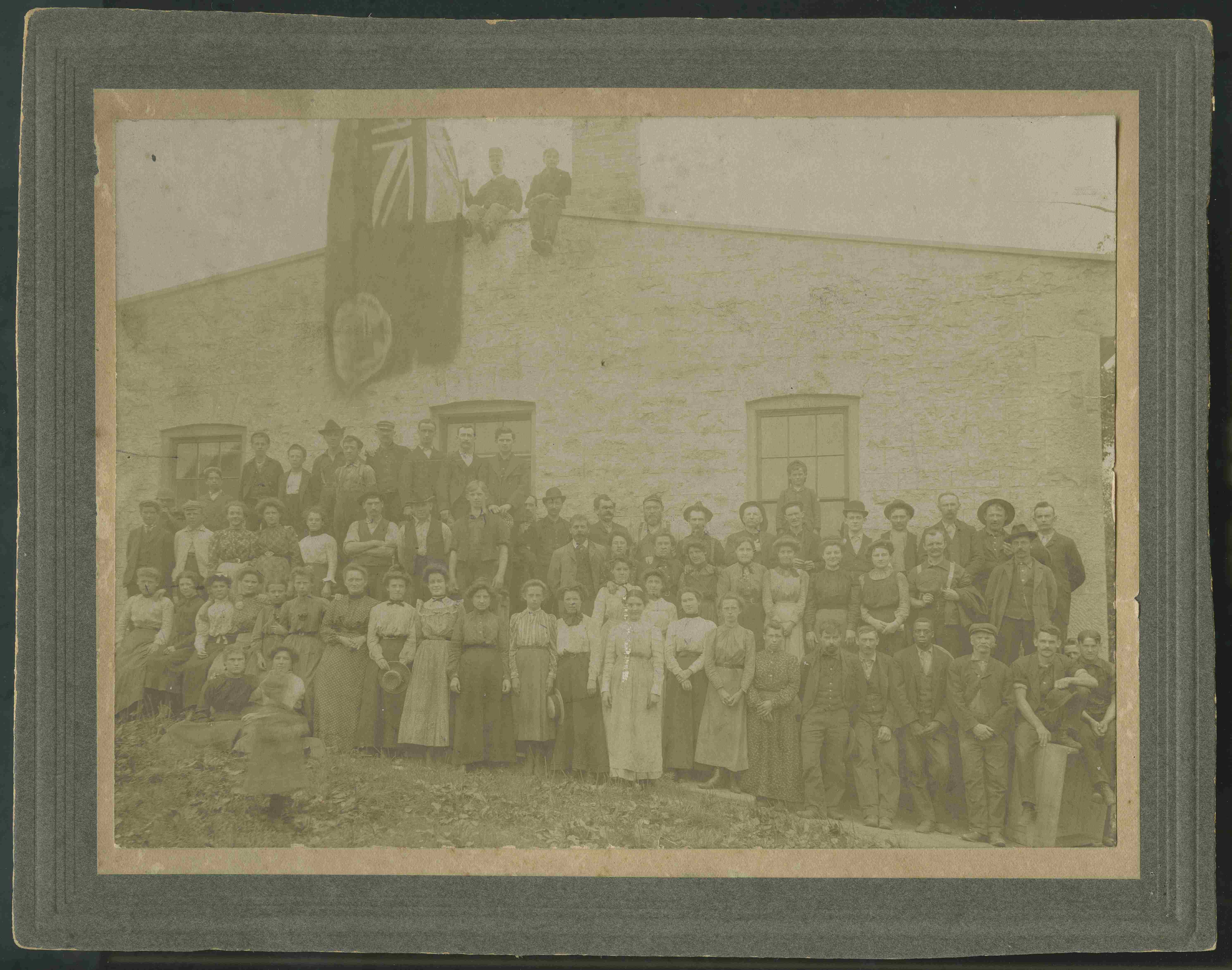
Figure 4: Mounted group portrait of employees of the George Pattinson Woollen Mill casually posed in several rows outside of a stone building. Two employees are sitting on top of the building with a flag, and a blurry child is visible walking through the frame at bottom left. Source: University of Waterloo Library, Special Collections & Archives, George Pattinson Woollen Mill fonds, GA227-3-17, Woollen Mill employees, [ca. 1900].
Figure 4 shows a photograph of woollen mill employees from what is likely the turn of the 20th century. Indicating that there is a Black person, whose name is unknown, in the front row, a few people from the right, would be an efficient way to flag the presence of a non-white employee, but doing so instantly others this person as notable simply because they are Black. Their presence, however, is historically significant given how uncommon it was for the lives of Black people living and working in the Region of Waterloo during this period to have been documented. And this point is crucial: it is not that it was uncommon for Black people to have lived and worked in the region, but it is instead uncommon for their lives to have been documented and for related records to have been maintained by institutions like my own.[52]
We do not yet have an answer for how to address this issue, and we have only just begun internally discussing how to proceed. One possible approach may be to create a new thematic area tag to pull together records in SCA holdings reflecting, pertaining to, and capturing the lives of non-white people. A tag at the fonds or collection level would immediately signal to researchers that information about equity-seeking communities, for example, is present within a particular set of records. These pointers would eliminate the need to rely on keywords alone to indicate the presence of records related to BIPOC groups or individuals and would leave it up to the researcher seeking the records to determine whether they were in or out of scope.[53] Another way forward may be to mirror the identification of BIPOC-related records in our holdings with the identification of records related to white people, and by extension whiteness, in those same holdings. Doing so efficiently at the file and item level is beyond the scope of what SCA can currently accomplish, but Armando Suárez’s review of the actions being undertaken by Princeton’s archival description and processing team points to an initial way forward.[54] As part of the team’s work, information about the perspective of the record creator(s) is being added to fonds and collection overviews. For example, the notation “largely from the perspective of settlers” is used to contextualize the Western Americana Miscellaneous Manuscripts, indicating up front the type of narrative and social position that frames the corresponding records. A similar approach could be reasonably introduced to SCA’s fonds- and collection-level overviews of local history holdings, which often already include a note about a family’s ancestry. Indicating that the family is also white and of a particular social and economic class would better contextualize both the nature of their lives and the records with which they are associated.
From a theoretical standpoint, Antonina Lewis’ notion of archival fragility offers additional guidance by putting a name to what is signalled by not acknowledging or acting to address the codified distinctions between “white” and “not white” in the archives. As Lewis explains, “Archival fragility subsumes the realities of people who experience records as barbs, barriers, and weapons under a professionally normalized construct of the greater historical good of the archival mission.”[55] Put another way, by choosing a hubris rooted in the sanctity of archival neutrality over a humility rooted in the relinquishment of power and a destabilization of the way things have always been done, the archivist becomes complicit in perpetuating harm. As an example of archival fragility, Lewis points to concerns about the long-term preservation of repatriated records, whereby misdirection about record safety is used to safeguard archival power. I propose that this type of concealed evasion may be equally at play when the identification and remediation of overt whiteness in legacy finding aids is framed as an impossible undertaking requiring too much work. By focusing on comfortably familiar neoliberal deflections like time and resources, archival fragility side-steps meaningful, action-oriented change. This rejection of accountability can also be understood as a manifestation of what Eve Tuck and K. Wayne Yang call settler moves to innocence, specifically “those strategies or positionings that attempt to relieve the settler of feelings of guilt or responsibility without giving up land or power or privilege, without having to change much at all.”[56] Combined, archival fragility and settler moves to innocence can be used to interrogate and call into question the prevalence within academia of equity, diversity, inclusion, and reconciliation statements that fail to yield meaningful and sustained change. For those unwilling to cede power or engage with difficult truths about (contemporary) archival practice, these types of statements become a refuge from the difficult work of enacting change rather than mechanisms through which equity and reconciliation work can be enacted in and through day-to-day archival practice.
In terms of further work, it is the extent of what must be (un)done that presents one of the biggest challenges. While SCA staff have begun identifying problematic content and intentionally improving the findability of records reflecting marginalized peoples and pasts, the effort is not a dedicated or sustainably resourced endeavour. It is work that, for logistics and efficiency’s sake, has been and will continue to be integrated into the ongoing review of records as part of database migration and a push to share more of the department’s digitized holdings online. Although we collectively understand the work to be ongoing and long term, we lack a plan for ensuring that it does in fact continue or a method for measuring success beyond pointing to record updates and newly created content warnings. Discussions about ensuring the future sustainability of the work or about the potential ramifications of a significant change in department staff or library administration have yet to take place. Where we have made headway, however, is in formalizing and documenting equity and reconciliation work in governing department policies and workflows; we have also begun the process of updating donor agreements to make clear the department’s commitment to these values. Doing so ensures that the motivating principles are woven into the entirety of the department’s operations, minimizing the potential for wholesale dismissal or redirection of the work moving forward.
Conclusion
While there is no easy or universally applicable way to integrate equity- and reconciliation-informed thinking into archival practice, starting the process requires acknowledging the shortfalls of the descriptive records in our care and identifying grounds for intervention that best align with the mandate of our organizations, the people using the records, and the histories of those people and places we are tasked with documenting. Often this means taking a critical look at how the diversity of our personal experiences and professional environments, or lack thereof, impacts our practice. There have been long-standing discussions in archival literature about the need for descriptive interventions, but contributions by Canadian practitioners have been notably absent. This article is an attempt to call in and make space for those members of the archival profession who are attempting to bridge broader theoretical and professional discussions with their day-to-day practice. There is no single right way to do equity and reconciliation work, and the time to start implementing change is always now. It is hoped that talking openly about the context and thinking behind changes to SCA’s approach to language in archival descriptions will prompt other practitioners to reflect on areas for improvement within their own practice to make the seemingly insurmountable incrementally achievable.